This work aims to physically model the acoustic characteristics of compact 2D manifolds (i.e., shells) that do not necessarily exist in the reality. For example, a Klein bottle cannot be embedded in three-dimensional Euclidean space without self-intersection. This makes it impossible to bring an actual Klein bottle to hear its sound, but it does not necessarily prevent us from hearing its sound in a virtual environment. In this paper, we introduce a framework to synthesize the reverberation sound of (non-)orientable 2D topologies such as the Klein bottle.
01 — Abstract
1. A framework of physically modeling the wave propagation on compact two-dimensional (2D) manifolds is presented.
2. Closed-form expressions for the eigenfrequencies and mode shapes of the (non-)orientable topologies and study their acoustic characteristics are introduced.
3. The modal structures are verified through comparison with finite-difference time-domain (FDTD) simulations.
4. Discussions on the mode morphing behavior of the modal structures under variation of the shapes and the boundary conditions are included on the paper.
02 — Method
The method is based on the modal decomposition technique. Specifically, closed-form expression for the acoustic modes of 2D manifolds with various boundary conditions are studied by constructing a quotient space for each manifold, identifying equivariance relations in the quotient space, and solving the wave equation under the equivariance constraints. The resulting modal structures are then used for reverberation synthesis by a convolution reverb framework.
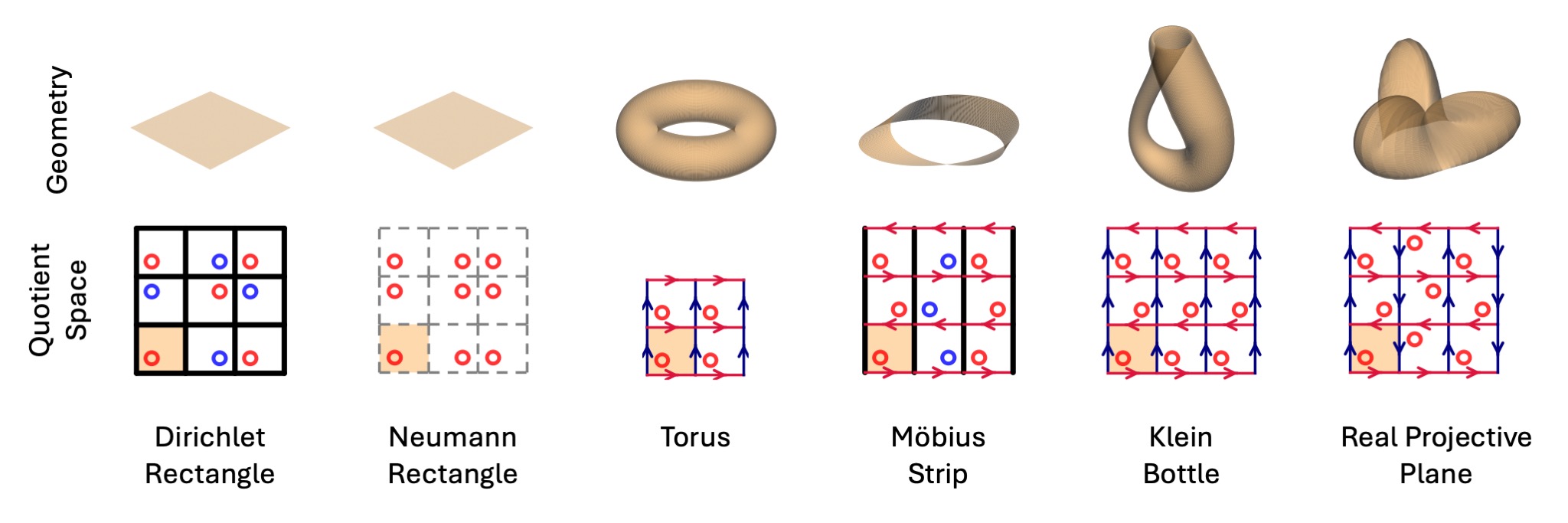
Figure 1. Summary of the example geometry and the quotient space of each topologies. The subspace colored in orange corresponds to the fundamental domain, and the arrows indicate how the boundaries are identified to construct the quotient space. The resulting modal structure is then used for reverberation synthesis.
03 — Listening Study
Reverb audio files synthesized using our proposed method. The audio are synthesized using either the closed-form modal solutions or the FDTD-simulated impulse responses.
Reverberation rendering results convolved using the impulse responses synthesized using the modal approach. The synthesis parameters follow the settings described in the "Impulse Responses" tab.
Flute (T60: 1.0 sec @100Hz, 0.5 sec @1000Hz)
Brass (T60: 4.0 sec @100Hz, 1.0 sec @1000Hz)
Comparison of the impulse response (IR) synthesized by our proposed modal method against the FDTD simulation as the ground truth. The IRs are synthesized with a Rayleigh damping model on top of the same FDTD/modal structure. Spectra of the responses without damping can be found in the paper. Unless otherwise specified, the synthesis configuration is as follows: Dimension of the manifold: \(L_x \times L_y = 7 \times 5\) m. Wave speed: \(c = 343\) m/s. Discretization: \(\Delta x = 0.1\) m, \(\Delta t = {\Delta x}/{\sqrt{2}c}\) s. Source position: \((1.96, 0.825)\) m. Receiver position: \((2.33, 3.33)\) m.
Damping Parameter (T60): 8.0 sec @ 100 Hz; 6.0 sec @ 1000 Hz
| Model | Dirichlet | Neumann | Torus | Möbius | Klein | RP2 |
|---|---|---|---|---|---|---|
| FDTD |
—
|
—
|
—
|
—
|
—
|
—
|
|
Modal
|
—
|
—
|
—
|
—
|
—
|
—
|
Damping Parameter (T60): 4.0 sec @ 100 Hz; 1.0 sec @ 1000 Hz
| Model | Dirichlet | Neumann | Torus | Möbius | Klein | RP2 |
|---|---|---|---|---|---|---|
| FDTD |
—
|
—
|
—
|
—
|
—
|
—
|
|
Modal
|
—
|
—
|
—
|
—
|
—
|
—
|
Comparison of our reverb against variations of the geometrical morphology. The wave speed is set to \(c=343\) m/s, and the damping is set to the same as Sample 01 in the impulse response experiment.
Varying \(L_x\) with fixed \(L_y=1.0\) m.
| \(L_x\) (m) | Torus | Möbius | Klein | RP2 |
|---|---|---|---|---|
| 0.1 | — |
— |
— |
— |
| 0.5 | — |
— |
— |
— |
| 1.0 | — |
— |
— |
— |
| 2.0 | — |
— |
— |
— |
| 10.0 | — |
— |
— |
— |
04 — Evaluation
Objective metrics on the synthesis outputs. ↑ = higher is better, ↓ = lower is better. Given the FDTD modal frequencies \(f_{mn}^\mathrm{fd}\) and the closed-form modal frequencies \(f_{mn}^\mathrm{cf}\), we compute the average relative error across all modes as \[\varepsilon_f = \frac{1}{M}\sum_{m,n}\frac{|f_{mn}^\mathrm{cf} - f_{mn}^\mathrm{fd}|}{f_{mn}^\mathrm{fd}}\] where \(M\) is the total number of valid modes considered. Similarly for the eigenfunctions, we compute the mean cosine similarity between the FDTD \(\tilde{\phi}_{mn}^\mathrm{fd}\) and closed-form modes \(\tilde{\phi}_{mn}^\mathrm{cf}\) as \[\mathrm{MAC} = \frac{1}{M}\sum_{m,n}\frac{|\langle\tilde{\phi}_{mn}^\mathrm{cf}, \tilde{\phi}_{mn}^\mathrm{fd}\rangle|^2}{\|\tilde{\phi}_{mn}^\mathrm{cf}\|_2^2\|\tilde{\phi}_{mn}^\mathrm{fd}\|_2^2}.\]
| Model | \(\varepsilon_f\) (%) ↓ | \(\mathrm{MAC}\) ↑ |
|---|---|---|
| Dirichlet Rectangle | 0.03 | 0.944 |
| Neumann Rectangle | 0.03 | 0.875 |
| Torus | 0.03 | 0.834 |
| Möbius Strip | 0.02 | 0.944 |
| Klein Bottle | 0.02 | 0.932 |
| Real Projective Plane | 0.03 | 0.929 |
The proposed FDTD method achieves an average modal frequency error of 0.02% and a mean cosine similarity of 0.932 for the Klein bottle geometry, demonstrating high fidelity in capturing the modal structure compared to the closed-form solution.
Yet, the gap of the MAC metric from 1.0 indicates that there are still discrepancies, which can be attributed to the numerical dispersion and discretization errors inherent in the FDTD method, as well as potential differences in how the modes are normalized and sampled.
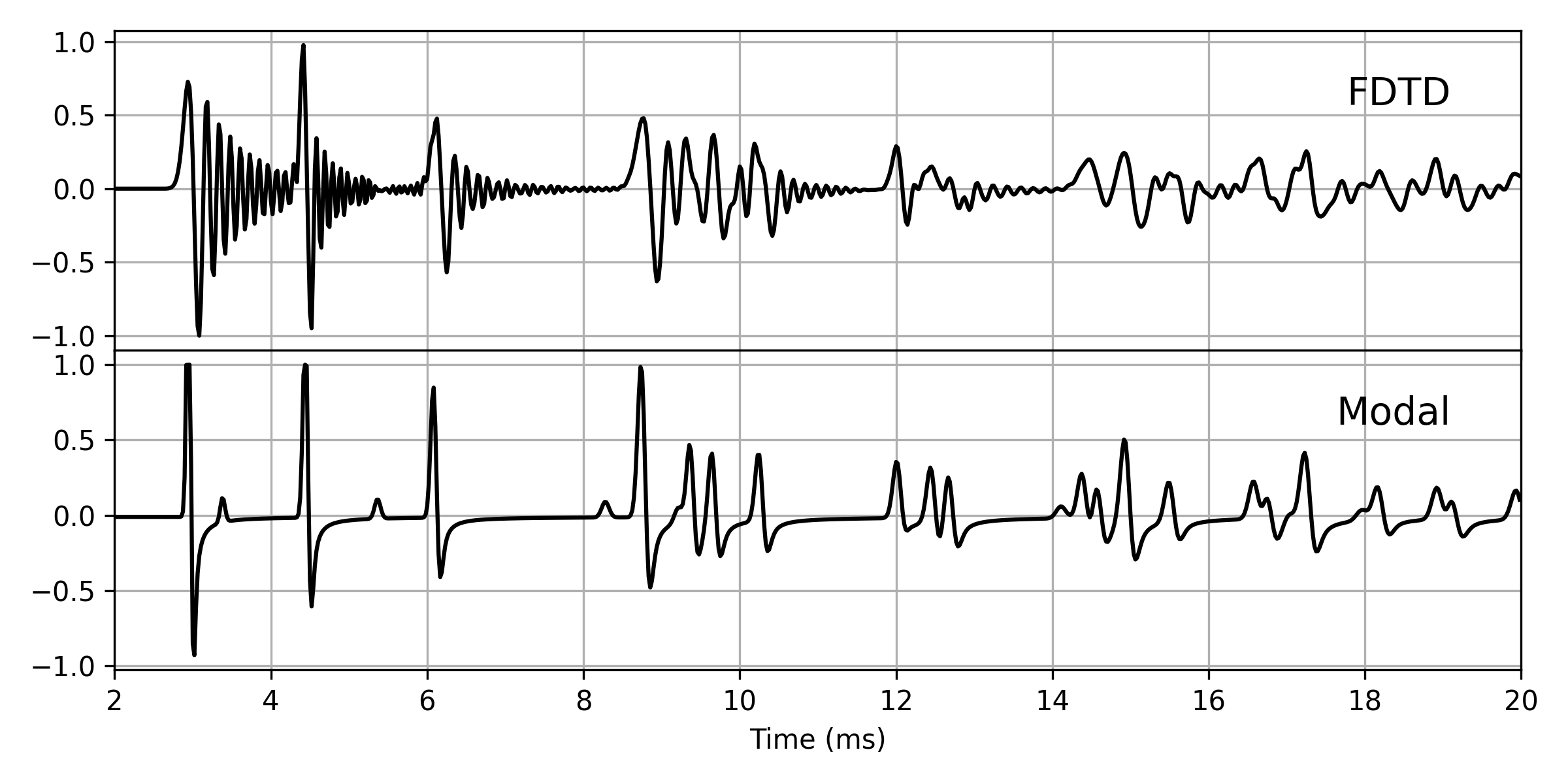
Figure 2. Waveform of the impulse response synthesized for the Klein bottle geometry, showing the numerical dispersion effects in the FDTD simulation (top) and the idealized modal solution (bottom).
04 — Reference
@inproceedings{kleinreverb,
    title     = {Modal Structure of Plate Boundaries and Klein Bottle Reverberation},
    author    = {Lee, Jin Woo and Rau, Mark},
    journal   = {The 29th International Conference on Digital Audio Effects (DAFx26)},
    year      = {2026},
}